




This table compares statutory sick-pay replacement rates across 10 European countries — how much of your wage you keep during an ordinary illness, how the rate changes for a long absence, and how many days go unpaid at the start. Every figure comes from TrendBite's national sick-pay calculators, each verified against the country's official social-security authority.
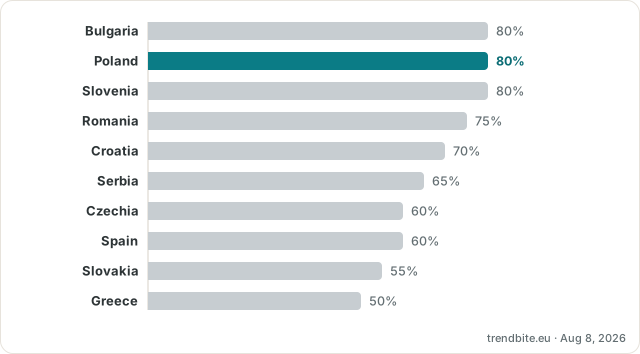
Under the rules in force in 2026, ordinary sickness pays the highest share of the reference wage in Bulgaria, Poland and Slovenia (80%) and the lowest in Greece (50%) — a gap of 30 percentage points.
Embed on your page
Applies to interactive views; the image keeps the brand colour.
| # | Ordinary sickness (2–4 weeks) | Long-term sickness | Unpaid waiting days | |
|---|---|---|---|---|
| 1 | Bulgaria | 80% | 80% | 0 |
| 2 | Poland | 80% | 80% | 0 |
| 3 | Slovenia | 80% | 90% | 0 |
| 4 | Romania | 75% | 75% | 1 |
| 5 | Croatia | 70% | 80% | 0 |
| 6 | Serbia | 65% | 65% | 0 |
| 7 | Czechia | 60% | 72% | 0 |
| 8 | Spain | 60% | 75% | 3 |
| 9 | Slovakia | 55% | 55% | 0 |
| 10 | Greece | 50% | 50% | 3 |
Methodology
Figures come from TrendBite's per-country sick-pay calculator pages, each verified against the national social-security authority linked in every row. Rates are the statutory replacement percentage of the reference wage under the rules in force in 2026; each row's date shows when its calculator's parameters were last checked against the source. The ordinary-sickness column reflects a typical two-to-four-week absence: in Spain 60% applies from day 4 to day 20, in Romania 75% applies to leaves of 15 days or more (55% up to 7 days, 65% for 8–14 days), in Slovakia the first 3 days are paid at 25%, and in Bulgaria the employer pays the first 2 days at 70%. The long-term column shows the rate after a prolonged absence: Czechia 72% from day 61 (66% on days 31–60), Spain 75% from day 21, Slovenia 90% after 90 days, Croatia 80% after six months; elsewhere the rate does not change. Unpaid waiting days are the opening days of an ordinary illness for which no statutory benefit is paid: three in Greece and Spain, one in Romania. Most countries also cap the benefit or its base, so high earners receive a smaller share of their wage. No currency conversion is applied — every value is a rate or a day count.
Sources
- Bulgaria (): nssi.bg
- Czechia (): cssz.cz , zakonyprolidi.cz
- Greece (): taxheaven.gr , e-efka.gov.gr
- Spain (): seg-social.es , boe.es
- Croatia (): hzzo.hr , zakon.hr
- Poland (): zus.pl
- Romania (): legislatie.just.ro
- Slovakia (): socpoist.sk , socpoist.sk
- Slovenia (): zavarovanec.zzzs.si
- Serbia (): paragraf.rs